
Boat and RV Insurance in Carson Valley: Where Home, Auto, and Umbrella Policies Meet
A Carson Valley guide to separating boat, travel trailer, auto, home, and umbrella exposures—from towing and storage to wildfire and business use.
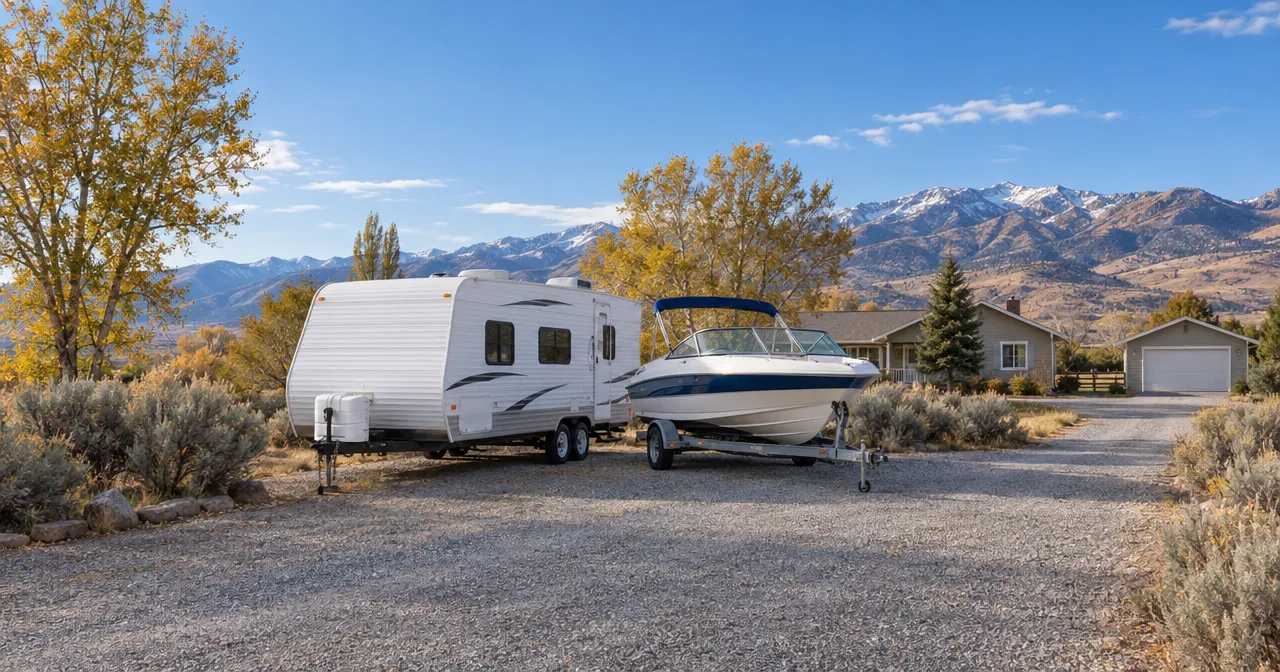
A Gardnerville household can have a home, two daily drivers, a travel trailer in the driveway, and a boat ready for a weekend on the water. It is tempting to think that the home or auto policy simply follows everything. In practice, a claim can involve several different questions: Who was liable? What property was damaged? Where was it? Was it being used personally or for business?
The useful way to review boat and RV insurance in Carson Valley is to follow the equipment through a trip: while stored at home, while being towed, while in use, and when a guest or another driver is involved. The answer is not a universal rule about one policy; it depends on the exact vehicle, insurer, endorsements, and exclusions. The examples below are illustrations, not coverage determinations.
Separate injury claims from damage to your own equipment
Imagine a pickup towing a travel trailer backs into another car at a crowded campground. There may be damage to the other car, damage to the pickup, and damage to the trailer. Liability coverage addresses covered injury or property damage to others; physical-damage coverage addresses your own insured vehicle or equipment when the cause of loss is covered. One limit does not automatically pay all three bills.
Nevada's Division of Insurance explains that its required auto liability protection is distinct from optional collision and comprehensive coverage on a vehicle. It also lists the state's liability minimums as 25/50/20. Those minimums are a legal floor for Nevada vehicles, not a recommendation for a household towing expensive equipment or protecting substantial assets. If your vehicle is insured or registered in California, ask for a review of that state's rules and the actual policy rather than applying Nevada's minimums across the border.
Keep a short inventory with the owner, regular drivers or operators, use, storage address, and policy for each pickup, motorhome, trailer, boat, and boat trailer. That inventory makes it much easier to see whether the same family activity is covered by the policies you expect.
At the boat ramp: do not assume homeowners coverage is boat coverage
A homeowners policy may provide limited protection for a small boat, but that does not make it a substitute for a watercraft policy. The National Association of Insurance Commissioners (NAIC) notes that homeowners coverage for a small boat can be limited and that liability protection may be limited as well; larger boats and personal watercraft may need separate coverage. The precise thresholds and exclusions are in your policy, not in a general example.
Picture a family launching a motorboat, taking guests aboard, and towing an inner tube. Ask who is insured if a guest operates the boat, whether passenger injuries and damage to another boat are covered, and whether towing people is within the permitted use. Then ask separate questions about the boat itself: Is the hull covered for theft, collision, storm damage, and damage during transport or storage? Are the motor, attached equipment, and boat trailer included, or do they have different limits or deductibles? What happens if the boat breaks down away from the launch? Do not assume an optional towing-assistance benefit is included.
How a boat is valued matters. The NAIC describes actual-cash-value, agreed-amount, and replacement-cost approaches for settling covered boat losses. A boat bought years ago may have a very different depreciated value from the cost of finding a comparable replacement. Compare the loss-settlement provision for a total loss and the treatment of partial repairs, rather than relying on the purchase price or the words “full coverage.”
For Carson Valley residents who keep a boat at home but use it on Northern Nevada lakes or in California, provide the insurer the usual operating waters and any unusual travel plans. Ask whether there are navigation, seasonal-use, storage, or operator restrictions. If you lend it to a friend or begin renting it, disclose that change first; personal-use assumptions may no longer fit.
On the road: a trailer is not the same as the vehicle towing it
A travel trailer has no engine; a motorhome does. That simple distinction changes the questions. If you tow a trailer with your SUV or pickup, ask whether the tow vehicle's liability policy applies to a covered accident involving the attached trailer and whether any restriction applies to its weight, type, or use. Do not treat liability from the tow vehicle as proof that the trailer itself is insured for damage. Request the trailer's own physical-damage terms for a rollover, theft, windstorm, hail, or wildfire at a storage location.
A motorhome needs a review of its own road-vehicle liability and physical-damage coverages. It also doubles as living space. Ask about personal belongings, permanently installed additions, attached accessories, campsite liability, emergency expense or temporary lodging options, and roadside assistance. These may be optional or limited, and the answer can vary depending on whether the RV is used for weekend trips, long stays, or as a residence. A travel trailer owner should ask the same living-space and campsite questions, even though the trailer is not self-propelled.
Consider a concrete split: a truck and trailer slide during a storm. The truck's collision coverage, the trailer's physical-damage coverage, and liability to another person are separate questions, each with its own conditions. If belongings inside the trailer are damaged, the RV policy and your homeowners policy may treat them differently. Have the agent identify where those belongings are insured, how theft away from home is handled, and which deductible applies. The NAIC's auto guide is useful for distinguishing liability, collision, and comprehensive coverage, but your actual policy and trailer endorsement determine what extends to the equipment behind the vehicle.
If a teen or another household member will drive the tow vehicle, do not stop at asking whether that person can drive the family car. Tell the insurer who will actually tow, how often, and what equipment they will pull. If a friend will borrow the RV or trailer, check permission and operator terms before handing over the keys.
Back home: storage creates a different property question
At a rural Douglas County address, a boat and RV may spend more time beside a detached garage than on the road. A storm or wildfire could affect the house, an outbuilding, and the stored equipment at once. They are not necessarily one insured item. The NAIC's homeowners guide identifies separate coverage categories for the dwelling, other structures, and personal property, and points out that detached buildings can need special attention. A boat or RV parked inside a covered garage should not be assumed to be insured as part of the garage simply because the structure is covered.
For a Gardnerville property, document the garage, shop, shed, fencing, and any upgrades, then check the other-structures limit and how each structure's loss would be settled. An enclosed workshop may be expensive to rebuild even when the main house's dwelling amount is accurate. Ask whether the insurer's replacement-cost estimate accounts for current construction costs and site-specific features. If you use the building for a business, store customer property, or keep tools for paid work there, disclose that use; a personal homeowners policy may not be designed for commercial property.
Wildfire and severe weather add a practical scheduling issue: do not wait until an evacuation notice to discover that boat and RV policies have different storage addresses or that the property inventory is outdated. The Nevada Division of Insurance's wildfire recovery guidance recommends keeping policy information and an inventory accessible and, after a loss, contacting the agent or carrier and documenting damage. Safety and evacuation instructions always come first. Separately, ask which policy would address covered smoke, fire, wind, or theft damage to the equipment, and what happens if it is moved temporarily for safekeeping.
If a seasonal home or rural second property is where the equipment actually lives, give that address to the insurer. Occupancy, storage, and location are underwriting details, not just mailing preferences. Do not assume the primary home's declarations page describes a different building or that its liability terms cover every use of a second property.
Check the umbrella against the actual boat and RV list
A personal umbrella policy can add liability protection above covered underlying policies and may address certain claims those policies do not. It does not repair your own boat, trailer, motorhome, or garage. The NAIC's umbrella explanation makes that distinction between excess liability and damage to your own property.
The important question is not merely “Do we have an umbrella?” It is “Which household exposures does this umbrella recognize, and what underlying limits must we maintain?” Give the agent a complete list of the vehicles, boat, personal watercraft if any, second home, and regular operators. Ask whether each watercraft or RV exposure qualifies, whether a separate boat or RV liability policy is needed underneath, and whether there are restrictions tied to size, power, use, or drivers. Umbrella contracts vary; do not assume every boat or motorhome is automatically included.
For example, if a boating injury claim exceeds the boat policy's liability limit, an umbrella may respond only if the watercraft and claim meet its terms and the required underlying coverage is in place. It is not a replacement for checking that the primary policy applies in the first place. Review the declarations and exclusions together when adding or replacing equipment.
Keep recreational and business use on separate tracks
A small-business owner may also own a trailer used to haul tools, a truck driven by an employee, or a boat used for paid outings. Even if the same person owns the home and the business, the exposures are not interchangeable. The NAIC's small-business guidance distinguishes commercial auto from personal auto and notes that a businessowners policy typically does not include commercial auto. It also warns that business-related vehicle use may be excluded from personal coverage.
If the pickup pulls a work trailer on weekdays and a camper on weekends, describe both uses. Ask whether a commercial auto policy is needed, how the trailer and its contents are insured, and which people or business entities are named. A business owner should review commercial general liability and, where relevant, commercial umbrella separately from a personal umbrella. Workers' compensation addresses employee work injuries under applicable law; health or group health insurance addresses medical benefits. Neither substitutes for vehicle or watercraft liability coverage. Do not assume a personally owned boat is covered just because the business has liability insurance, or vice versa.
A 15-minute coverage inventory before the next trip
Bring policy declarations and a list of equipment to one conversation. For each item, record its VIN or hull identification number where applicable, owner, storage address, usual use, regular operators, and current estimated value. Then work through these questions:
- While stored: Which policy covers the house, detached building, and the boat or RV? Which causes of loss, valuation methods, limits, and deductibles apply to each?
- While moving: What covers injury or damage to others from the tow vehicle or motorhome? What covers physical damage to the trailer or boat trailer in transit?
- At the destination: What covers boating liability, guests aboard, watersports, and campsite incidents? Are the operating area and drivers permitted?
- At higher claim amounts: Does a personal umbrella include the listed boat, RV, and property exposures, and are the required underlying limits met?
- When plans change: Who should be notified before you lend, rent, move, modify, or use the equipment for a business?
A clear answer to each question is more useful than a promise that everything is “bundled.” Keep copies of declarations and endorsements, and ask for an explanation of any limitation that is hard to understand. Coverage always turns on the issued policy and facts of a claim.
If your Carson Valley household has a boat, RV, multiple vehicles, or a rural property, request a personalized quote or coverage review from Larry Peyton Insurance. Our Gardnerville team can help map the policies together and explain the options clearly. For a different question, contact the team.